UNESCO 2022 Gold · PhD-track, UCC
Open to collaboration
Researcher · Engineer · Dublin
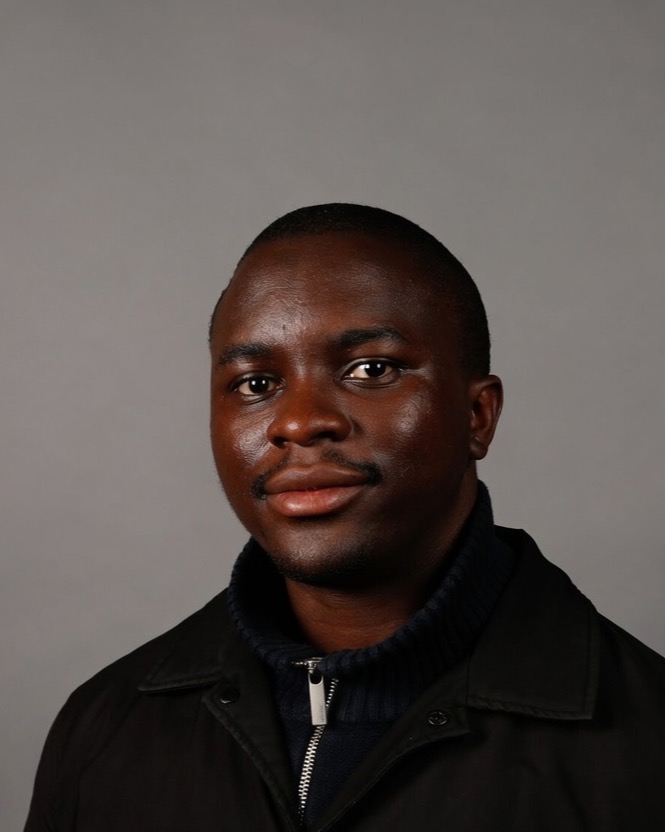
Saheed Faremi.
Researcher of the brain. Engineer of the systems people rely on.
Published
Brain Informatics · IEEE ICTAS
Built
Curnance · Etihuku · Gijima
Research
UCC · AICL Lab
Recognition
UNESCO Gold · Google NLP Hack
01 · About
A researcher who ships.
I am a PhD researcher at University College Cork, supervised by Luca Longo at the Artificial Intelligence and Cognitive Load Lab , working on unsupervised deep learning for EEG signal analysis. Before that I completed an MSc in Computer Science (machine-learning concentration) at Technological University Dublin with a 4.0/4.0 GPA, and a BSc in Information Technology at the University of Eswatini. Alongside the doctorate, I work as a data scientist and engineer, shipping the production systems that under-served users (geographically, economically, or computationally) depend on.
The research: EEG microstates are quasi-stable scalp topographies that segment ongoing brain activity into a discrete temporal alphabet. Find the recurrent patterns and you have a candidate indicator. My doctorate asks whether deep generative models (variational autoencoders with a Gaussian-mixture prior) can learn a microstate alphabet that is more stable across sessions and more predictive of behaviour than classical clustering. The aim is a representation reliable enough to support the detection of disorder-relevant brain states.
On the engineering side, I was founding engineer at Curnance, a multi-asset fintech platform where I shipped the admin console, wallet, and KYC subsystems, and a data scientist at Etihuku, where my LLM document-generation pipeline on Azure ML Studio cut manual document creation by 85% across three compliance regions. Infrastructure for under-served users demands the same rigour as infrastructure for everyone else; in practice, it usually demands more.
In 2022 I represented Eswatini at the UNESCO India-Africa Hackathon at Gautam Buddha University, Uttar Pradesh. Team Geeks_on_Fire (five people, five countries) won problem statement AGRI12 with an AI-assisted voice contact centre that lets farmers without smartphones report issues by phone and receive guidance in their own language. The win earned gold medals and a ₹3 lakh team prize.
Based in Dublin, Ireland. Travel for research. open to collaboration
Find the recurrent patterns and you have a candidate indicator.
02 · Research
EEG microstates with deep generative models.
EEG microstates are quasi-stable scalp topographies, typically four to seven canonical classes, that segment continuous EEG signal into a discrete temporal alphabet. The classical approach uses modified k-means clustering over the global field power maxima. It works, but it depends on hard choices (the number of states, the reference electrode, the band-pass) and the resulting segmentation can be brittle across sessions.
This project asks whether a learned latent geometry, via a variational autoencoder, produces a microstate alphabet that is more interpretable, more stable across sessions, and more predictive of behaviour than the classical pipeline.
Approach
- VAE. Single Gaussian latent prior; learn a continuous embedding of topography frames; segment by latent-space clustering or by direct decoder reconstruction error.
- GMM-VAE. Gaussian-mixture latent prior with one component per microstate class, so the segmentation falls out of the latent prior structure rather than a post-hoc clustering step.
- Architecture search. Sweep over latent dim, regularisation, and decoder choices; compare reconstruction-vs-segmentation tradeoff curves across architectures.
Recent publications
- Autoencoder-Based Models for Scalp EEG: A Systematic Review of Architectures, Applications, Latent Representations, Interpretability, and Validation
Morteza Akbari, Saheed Akinpelumi Faremi, Luca Longo
OSF Registries (registered systematic-review protocol) ·2026
- Integrating Convolutional Variational Autoencoders and the Gaussian Mixture Model for efficient manifold learning and clustering of spatially preserved EEG topographic maps
Saheed Faremi, Luca Longo
Brain Informatics ·2026
- Interpretable EEG Microstate Discovery via Variational Deep Embedding: A Systematic Architecture Search with Multi-Quadrant Evaluation
Saheed Faremi, Andrea Visentin, Luca Longo
XAI 2026 (Late-breaking work + Doctoral Consortium track), Fortaleza, Brazil. arXiv preprint. ·2026
- Explainable Disentangled Representation Learning of Recurring Brain Activation Patterns via Variational Autoencoders
Saheed Faremi
XAI World Conference 2025, Doctoral Proposals track ·2025
- Machine Learning Models for Identifying Factors Influencing and Predicting Malaria Among Children Under Five Years in Nigeria
Akinpelumi Saheed Faremi, Boluwaji Akinnuwesi, Elliot Mbunge, Petros M. Mashwama, Stephen Fashoto, Polite Zenzo Ncube, John Batani, Shamsudeen Ademola Sanni, Yinusa A. Faremi, Andile Metfula
IEEE ICTAS 2024 ·2024